Blog
10 Google Ads Mistakes that Waste Budget in 2026
Google Ads is now largely automated, with Performance Max, Smart Bidding and AI Max taking over more of the decisions.
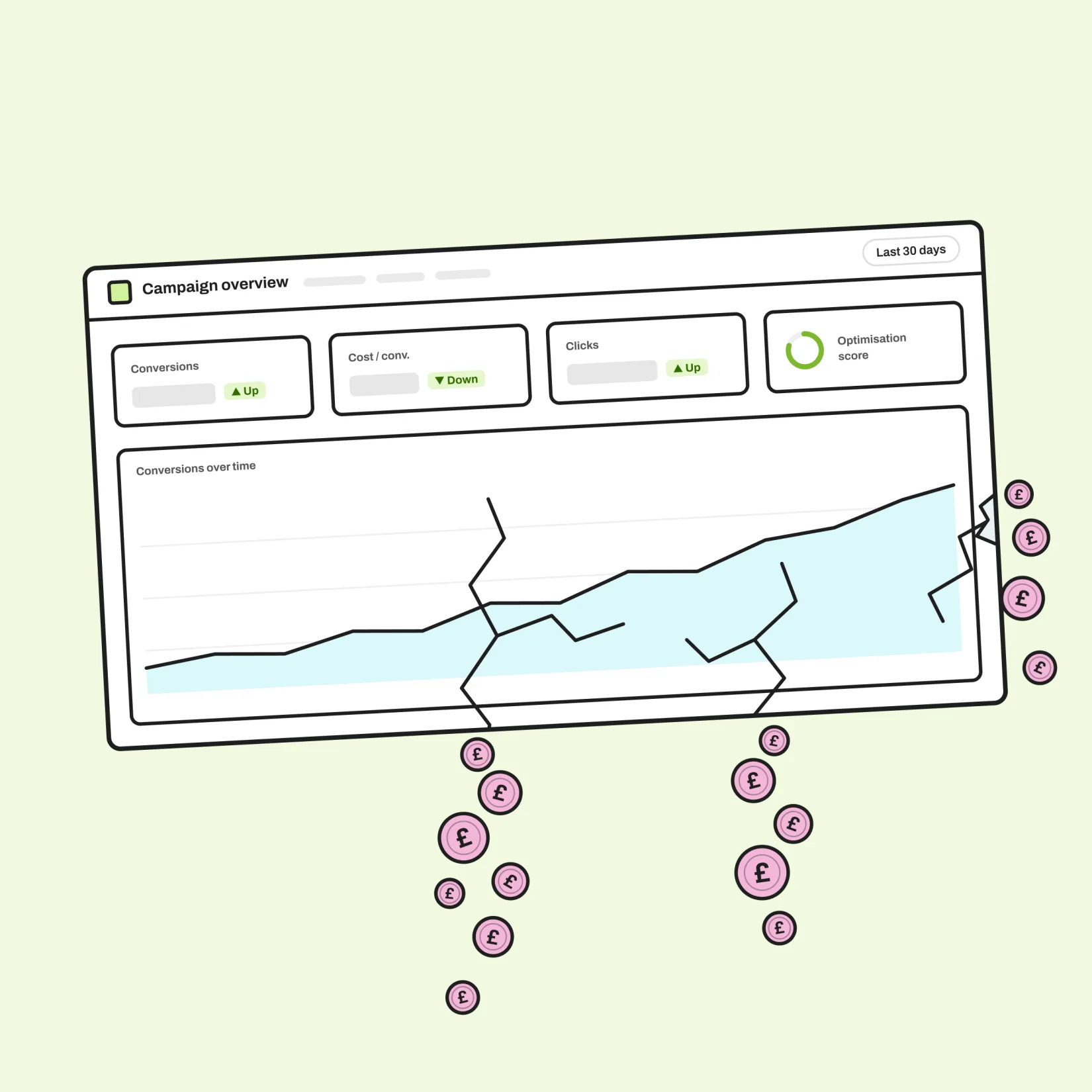
That has made some things easier, but it has also created a slightly different kind of problem. It is now perfectly possible to have an account that looks healthy at first glance — plenty of conversions, a reasonable CPA, a strong Optimisation Score — while a fair amount of budget is still being wasted in the background.
Usually, it is not one spectacular mistake. It is a combination of smaller ones: poor conversion tracking, loose targeting, bidding towards the wrong goal, or simply giving Google more freedom than the account is ready for.
In practice, we tend to see the same issues cropping up again and again. Here are ten worth checking now.
1. Optimising towards the wrong conversions
This is one of the first things we check in a Google Ads audit, because it has a knock-on effect on almost everything else.
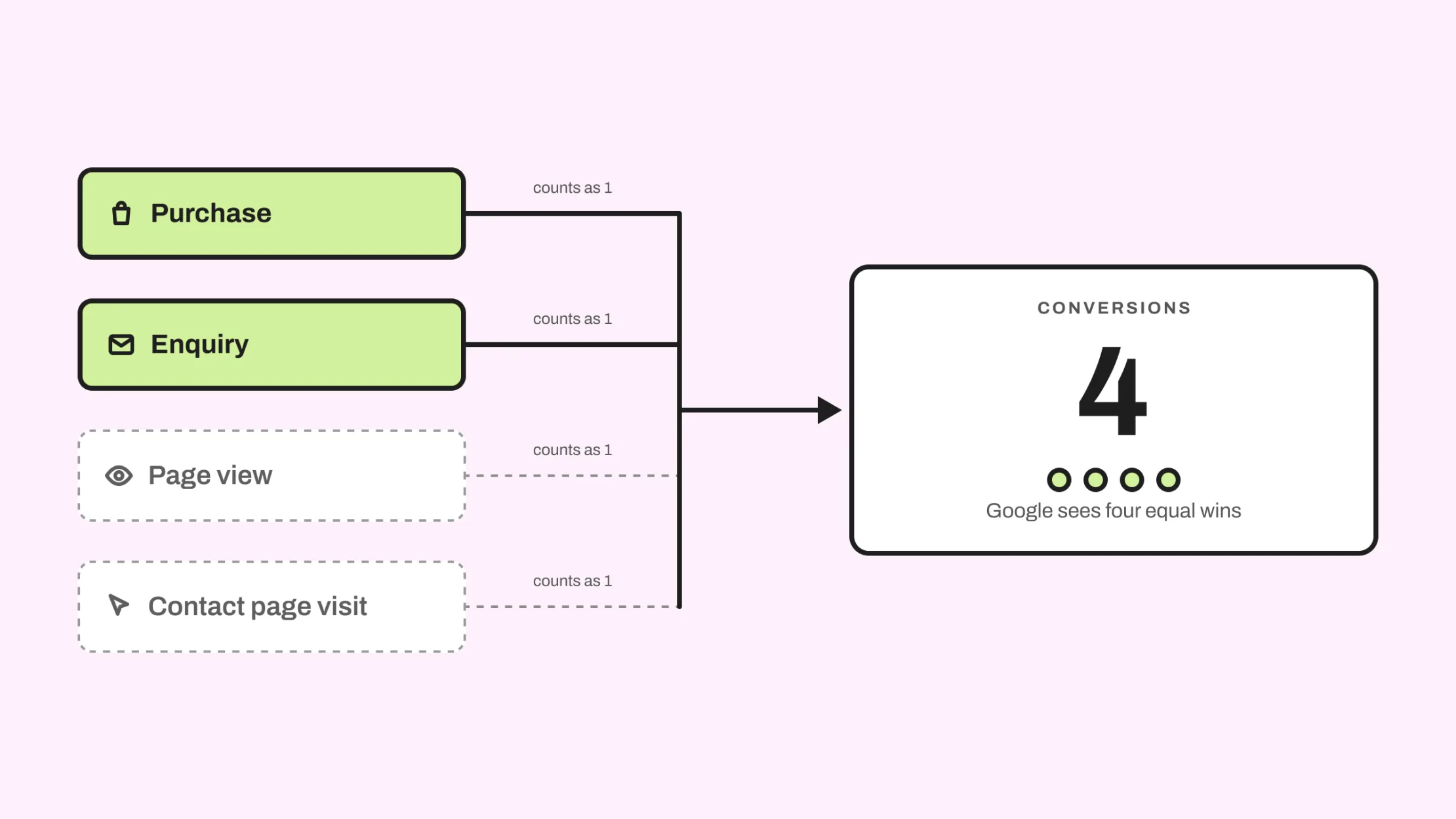
We still see accounts where page views, visits to a contact page or other fairly minor actions are being counted as Primary conversions alongside actual enquiries or purchases. If those actions are being used for bidding, Google has no reason to know that one is far more valuable than the other. It simply sees a goal and tries to get more of it.
That can leave you with a campaign reporting a healthy number of conversions while very little of that activity is translating into actual business. The reporting looks good; the sales team is less impressed.
It is worth going through your conversion actions and being fairly ruthless about which ones should actually influence bidding. Softer actions can still be useful to track as Secondary conversions, but they do not all need to steer the campaign.
Extra tip: Not every campaign needs to use the same conversion goals. If one campaign is focused on ecommerce sales and another is designed to generate enquiries, campaign-level conversion goals can be a much better fit than applying the same account-wide setup to everything.
2. Treating every conversion as equally valuable
Even when you’re tracking the right conversions, there’s another problem: they may not all be worth the same amount.
A brochure request, a qualified sales enquiry and a £5,000 purchase are three very different outcomes. If each one is simply counted as “one conversion”, Google has very little information about which type of result you would actually prefer more of.
For ecommerce, assigning value is normally straightforward because you can pass through the actual purchase revenue. Lead generation takes a little more thought. You might decide that an initial enquiry is worth £20 based on historic close rates, while a qualified lead is worth £100 because it has a much better chance of becoming a customer.
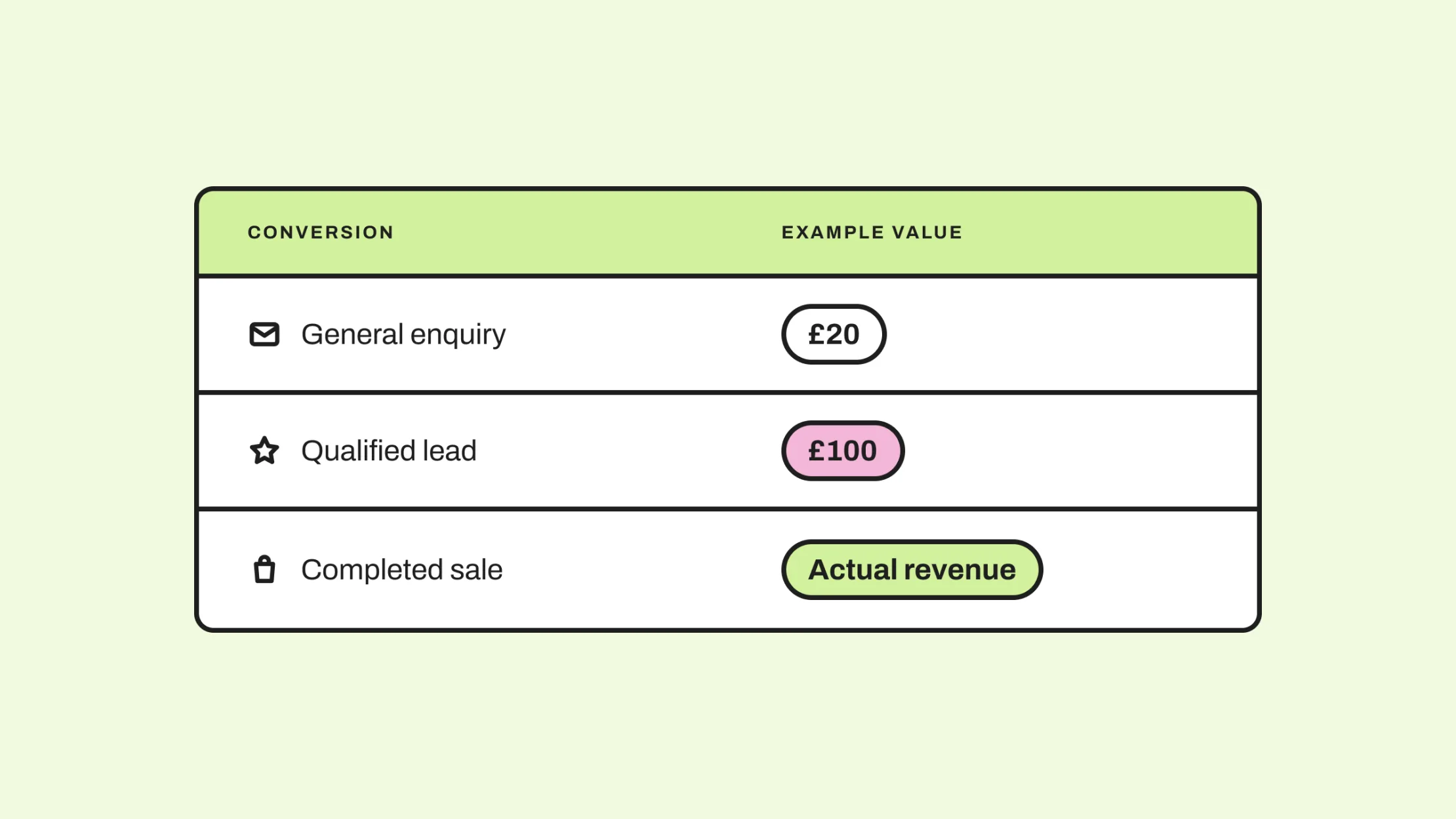
The values do not need to be perfect. They just need to be sensible enough to give Google a clearer steer. Once that is in place, bidding strategies such as Maximise Conversion Value or Target ROAS can optimise towards the value being generated, rather than simply trying to produce the biggest possible conversion count.
3. Not checking the search terms report
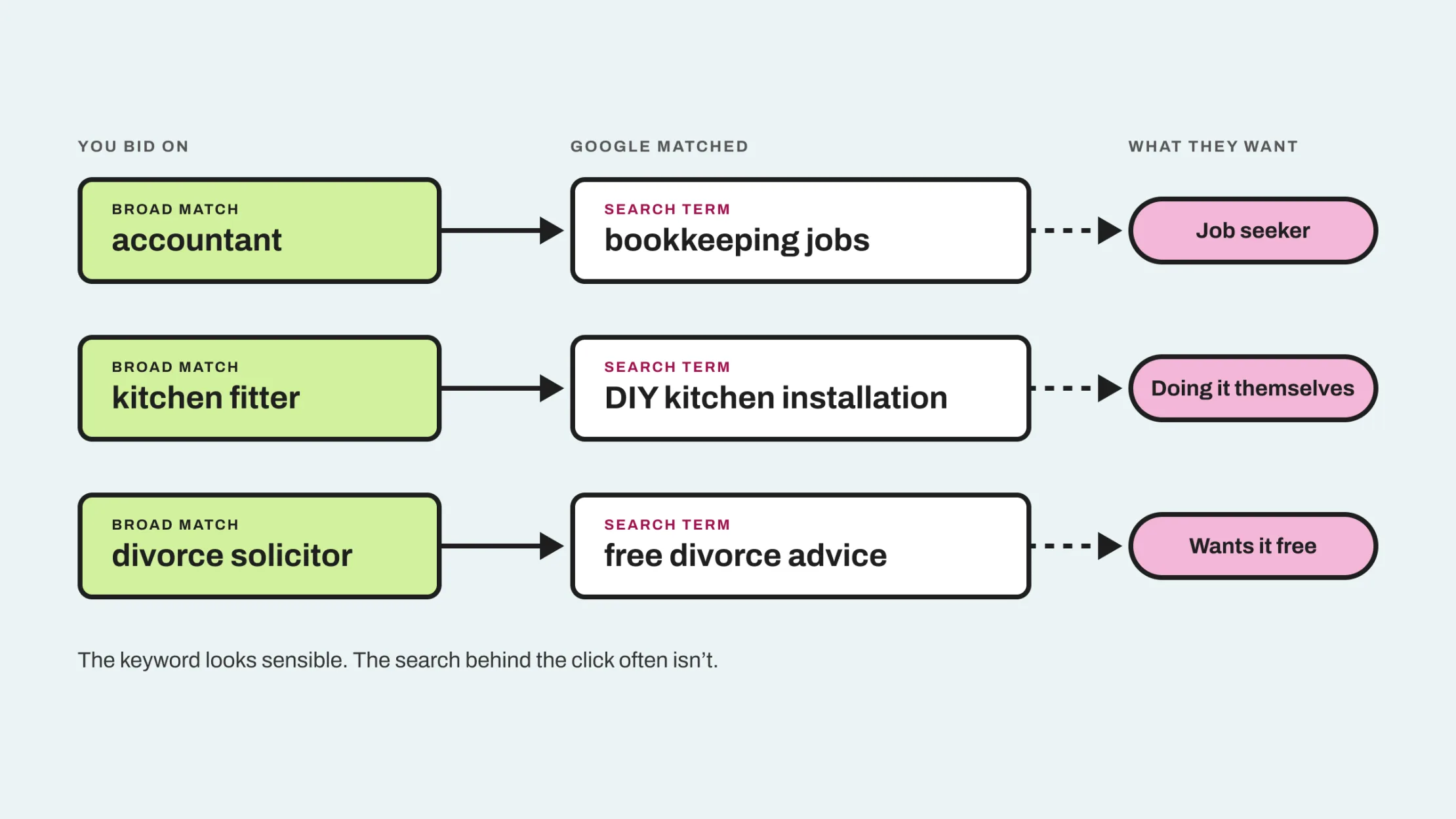
The keywords you add to a campaign are not always the searches you end up paying for, particularly when Broad Match is involved.
You might target a keyword that looks completely sensible on paper, only to find that Google has interpreted it rather generously once the campaign is live.
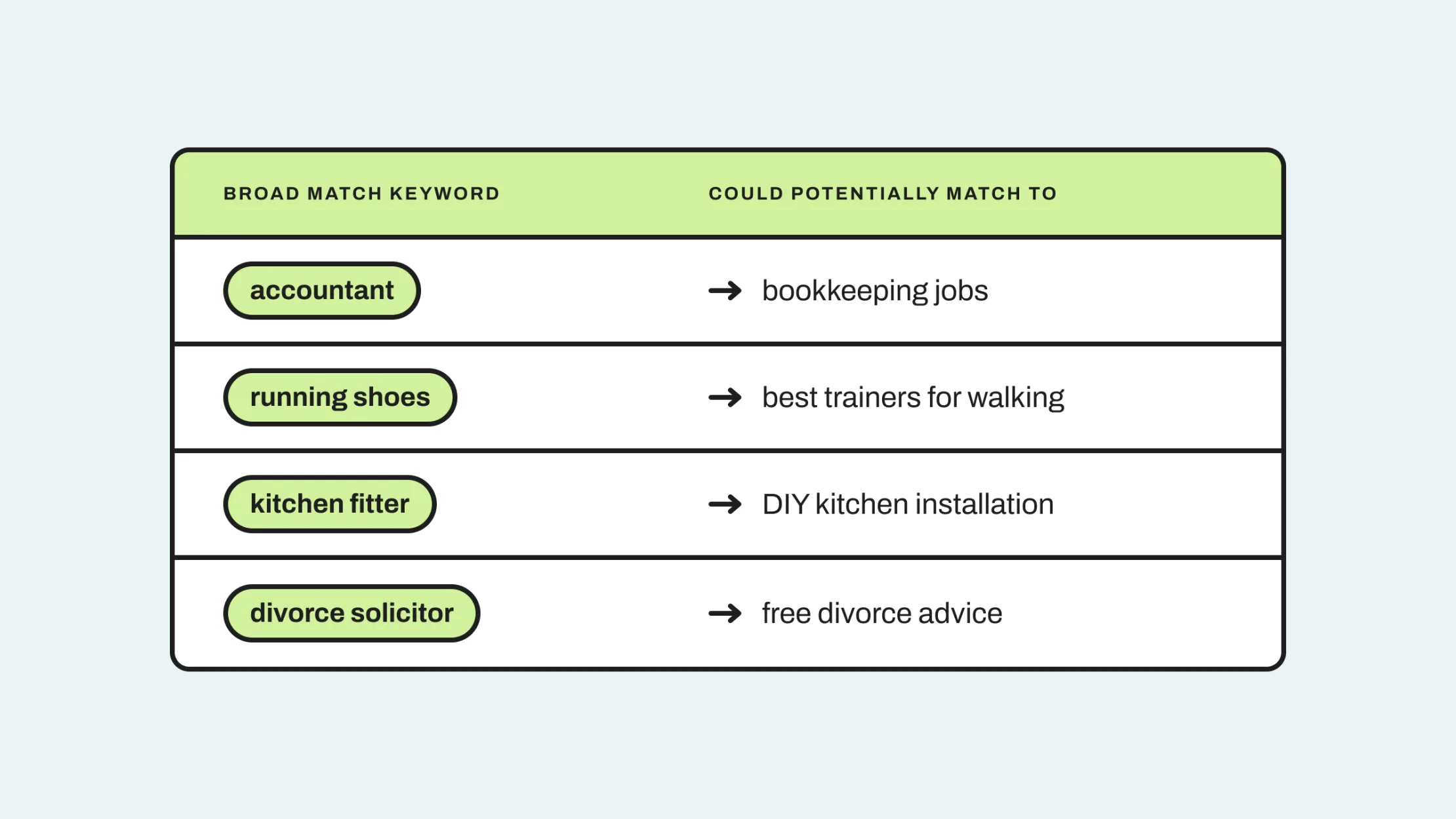
Some of those searches might still be useful. Others are clearly a poor fit, or show completely the wrong intent.
That’s why the Search Terms Report is still one of the first places we look when reviewing an account. It shows the actual searches people made before clicking your ads, so you can spot wasted spend, add negative keywords and pick up useful new search terms.
The biggest waste isn’t always from obviously irrelevant searches either. Often it comes from queries that look relevant at first glance, but are coming from people looking for jobs, free advice, DIY solutions or something slightly different from what you actually sell.
4. Giving Google too much freedom
Google Ads now has plenty of features that allow the platform to make more decisions on your behalf. Broad Match, Performance Max, AI Max, automatically created assets and Final URL Expansion can all work very well, and we use them regularly.
The mistake is turning them on without really checking what that means for the campaign.
Final URL Expansion can send users to pages you did not originally select. Automatically created assets can alter the way your ads appear. Broader targeting can take you into searches or audiences that Google considers relevant, even if you would never have chosen them yourself.
None of that is a reason to avoid automation. It is a reason to make sure the basics are in good shape before you give Google more room to work.
If conversion tracking is unreliable, or your exclusions are thin on the ground, more automation can simply help the campaign make the wrong decisions faster.
At Eyekiller, we open things up gradually, see what Google does with the extra freedom, and then decide whether it deserves any more.
5. Using the wrong location targeting
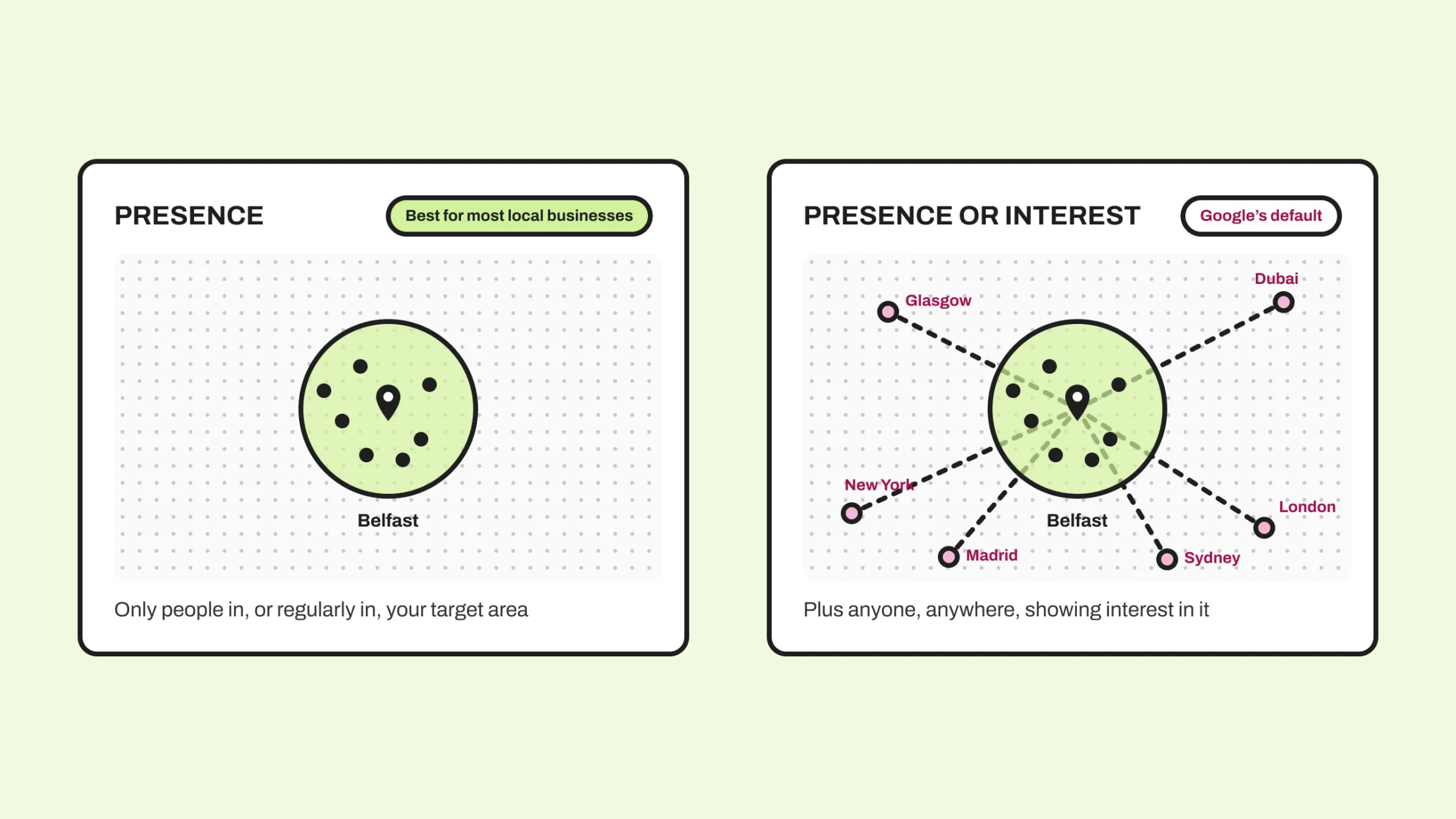
You might target Belfast in Google Ads and assume your ads will only show to people in Belfast. That isn’t necessarily the case.
Google’s default Presence or Interest setting can also reach people elsewhere who have shown an interest in your target location.
For most local and service-based businesses, “Presence only” is usually the safer option. If you’re a plumber serving Manchester, there’s probably little value in paying for a click from somebody in Glasgow who happened to search for something related to Manchester.
It should not be a blanket rule, though. Travel and hospitality are the obvious exceptions. Someone searching for a hotel in Edinburgh is very often sitting in London, Belfast or another country entirely when they do it, and limiting the campaign to people already in Edinburgh would cut out precisely the audience you want to reach.
6. Sending traffic to the wrong landing pages
Performance Max can use Final URL Expansion to reroute someone to a different page on your site if it decides that page suits their search better. It is on by default and can be genuinely useful on larger sites, where matching intent to the right content by hand is a losing battle.
It can also make some baffling choices. You may find paid traffic cheerfully arriving on a five-year-old blog post, your About Us page, an expired offer or something else you would never have picked as a destination.
If you are using Final URL Expansion, check which pages are actually receiving traffic and apply URL exclusions to anything you would rather Google left alone. Google itself recommends excluding non-commercial sections of a site. And occasionally the simplest fix wins: if there is only one page you genuinely want people to land on, just switch Final URL Expansion off.
7. Spreading your budget too thinly
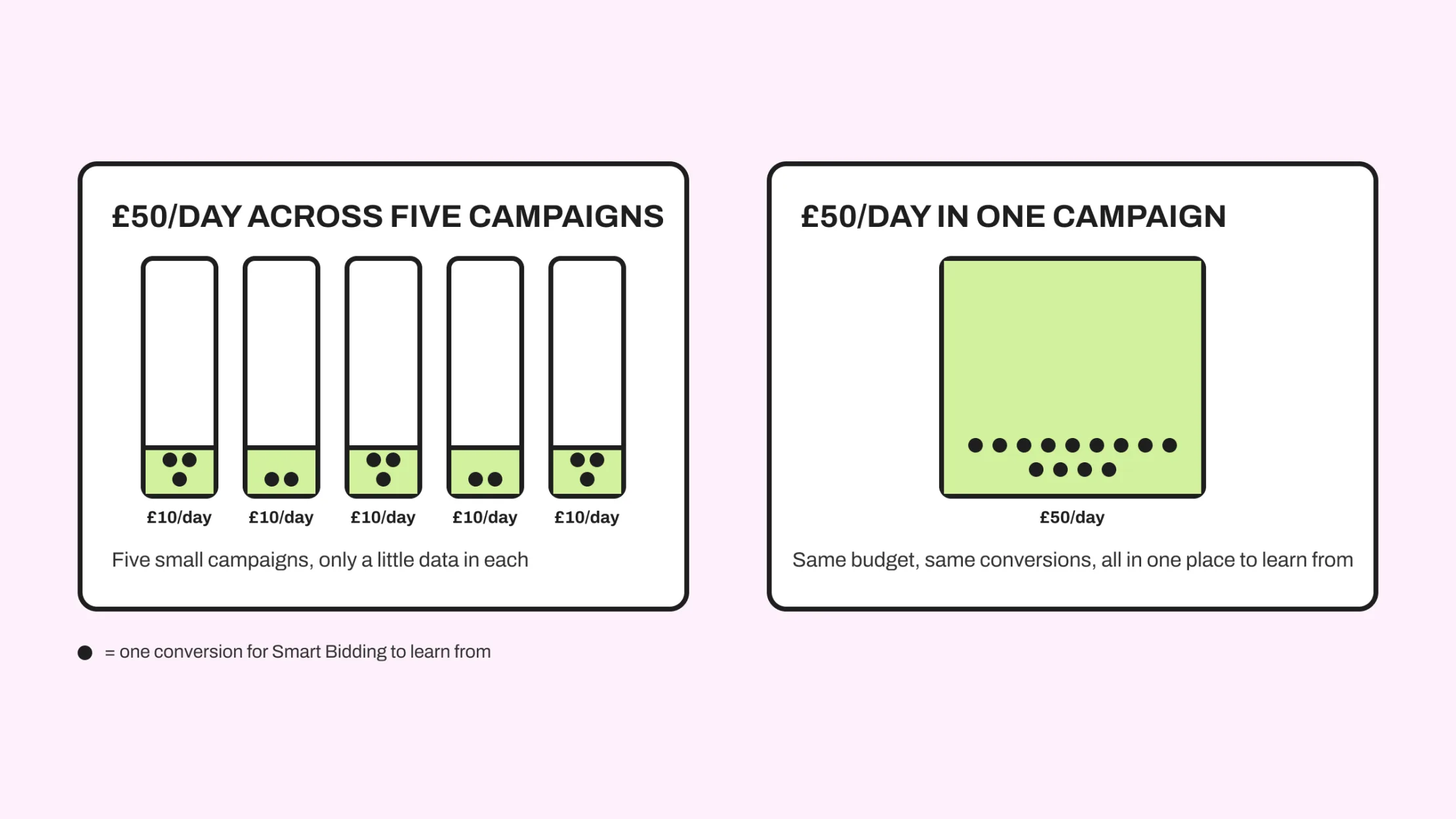
Google Ads accounts tend to become more complicated over time. A new service gets its own campaign, then a location, then a particular audience or product category, and before long a fairly modest monthly budget is being divided across far more campaigns than it needs to be.
That is not automatically a problem, but it becomes one when individual campaigns are barely generating enough volume to learn anything useful.
This matters particularly with automated bidding. If a campaign is only picking up a handful of conversions each month, Google has much less information to work with.
There are plenty of valid reasons to separate campaigns. Different budgets, locations, margins or business priorities can all justify it. The point is that there should be a reason beyond “we have always structured it this way”.
Five campaigns spending £10 a day each are not inherently more sophisticated than one campaign spending £50. In some cases, they are simply five small campaigns making life harder for themselves.
8. Setting unrealistic CPA or ROAS targets
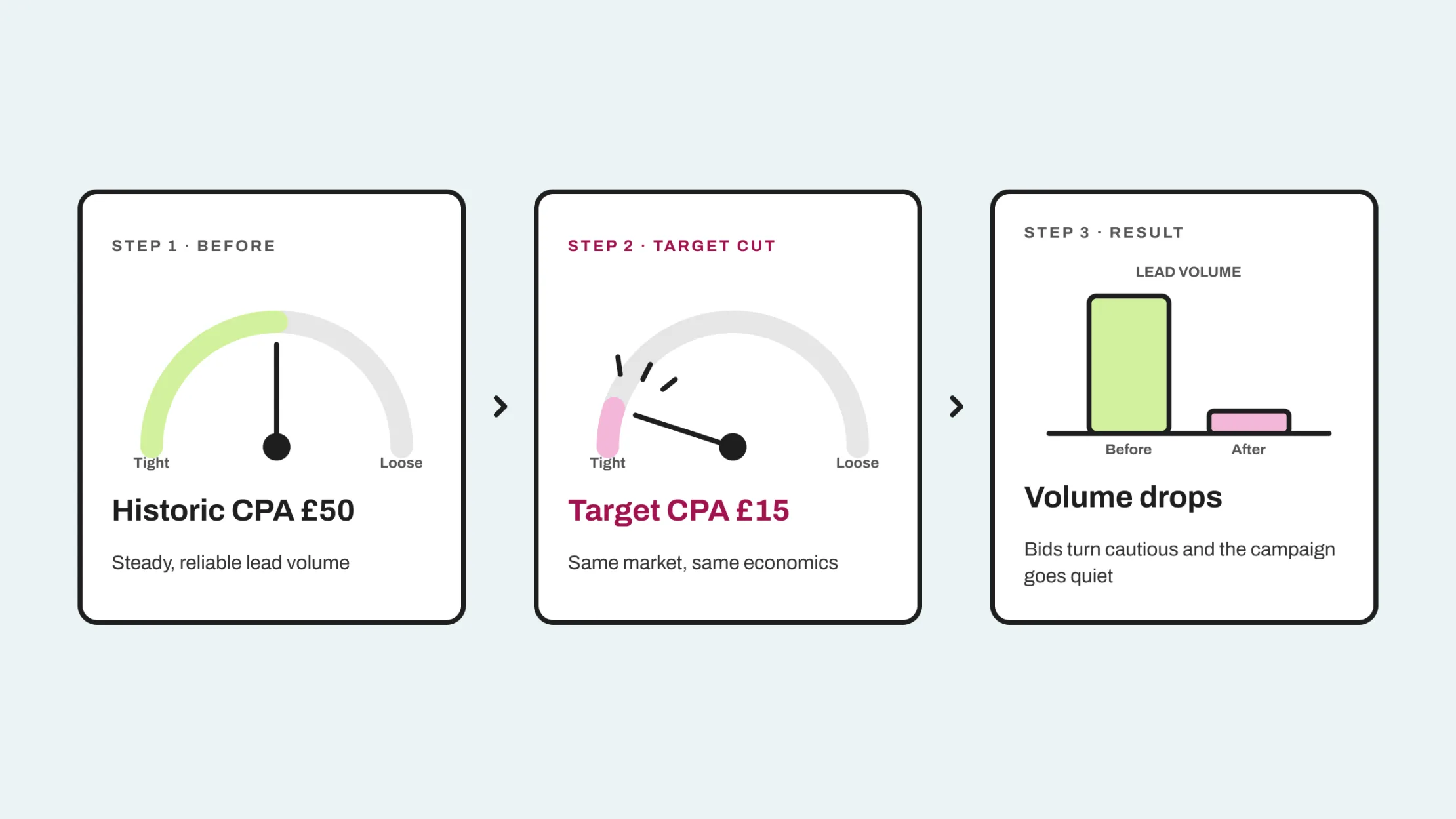
A Target CPA or Target ROAS is an instruction to Google's bidding system, not a wish list. If a campaign has reliably produced leads at around £50 each, dropping the Target CPA to £15 will not conjure the same customers at a third of the price. It will usually just make the campaign far more cautious, and far quieter.
The same goes for Target ROAS. If the target is pushed too high, Google has fewer auctions where it believes it can realistically achieve that return, which can reduce traffic and conversion volume.
Google’s own guidance makes clear that Target CPA bidding aims to achieve your target on average, while actual results still depend on things like competition and conversion rates. Target ROAS similarly uses your conversion values to decide how aggressively to bid.
Use historical performance and the economics of the business when setting targets, then adjust them gradually.
Extra tip: Google changed how target-based bidding behaves for campaigns limited by budget in August 2026, so it’s worth paying particular attention to campaigns running Target CPA or Target ROAS alongside tight budgets.
9. Losing people on the landing page
Winning the click is only half the job. If a visitor lands on a page that is slow, confusing or simply unconvincing, no amount of clever bidding or granular targeting will rescue what happens next.
A good landing page should make it immediately clear that the visitor is in the right place. The offer should match what they searched for and what the ad promised, and the next step shouldn’t require any detective work.
That means looking out for things like:
- slow mobile pages
- vague or buried calls to action
- unnecessarily long forms
- ads promoting something that’s difficult to find on the page
- generic homepages being used when a much more relevant service or product page exists
Landing page experience is also one of the components Google uses when assessing Search ad quality, alongside expected click-through rate and ad relevance.
10. Blindly following Google’s recommendations
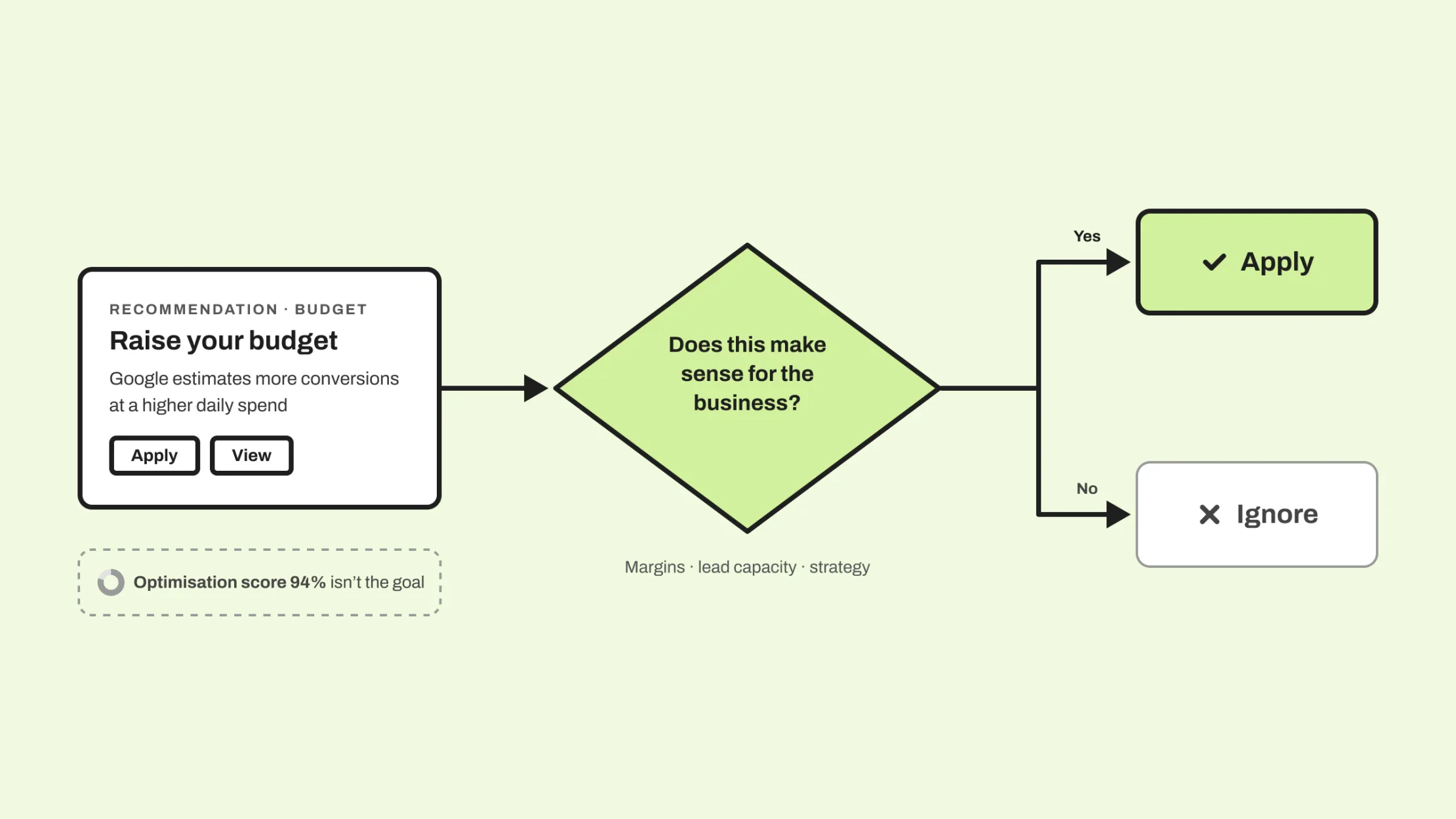
The Recommendations tab has its uses. It can surface missed opportunities, genuine account issues and settings worth a second look. What it is not is a to-do list you are obliged to clear.
Recommendations can cover bidding, targeting, keywords and all sorts of other settings, and Google will even let you auto-apply whole categories of them if you are feeling trusting. That does not mean every suggestion is right for the business. Google does not know that one service runs on wafer-thin margins, that you are keeping a campaign deliberately narrow, or that the client can only handle so many leads a week before the phone stops getting answered.
Optimisation Score deserves the same healthy scepticism. It is a useful nudge that there are recommendations worth reviewing, but chasing 100% is not the objective. Read the recommendation, understand what it will actually change, and decide whether it is useful
There is no prize for having a perfectly optimised score if the actual performance is worse.
Google Ads still needs proper oversight
Google Ads has become very good at handling the day-to-day, but "switch it on and walk away" was never really a strategy, and it is a worse one now than ever. Almost all wasted budget traces back to the same short list: poor conversion data, loose targeting, over-ambitious bidding targets, weak landing pages, or simply nobody checking what Google is doing with the freedom it has been given.
Encouragingly, most of these are very fixable. A well-structured account, accurate conversion tracking and a regular, honest review make a real difference.
If you’re not sure whether your Google Ads account is making the best use of its budget, we can take a look. An Eyekiller Google Ads audit covers your tracking, campaign structure, targeting, bidding and search activity, with a particular focus on where spend is being wasted and what we would change.
Let's Talk
Got a Google Ads account that could be working harder? Let's take a look.
Get in touch-
The Power of Subtle Website Animation
Why we turn down more animation than we build, and why that's the whole point.
-
How Designers Are Using AI Tools Responsibly
Here's how our team uses AI to earn back a bit of extra thinking time - and exactly where we draw the line.
-
ChatGPT Ads: Our Honest Verdict
Hear what our Senior PPC Specialist, Matt, has to say about ChatGPT ads.